Evaluating Information: What AI Research Teaches Us About Data Accuracy
When I ask my digital marketing students to research a strategic recommendation for a business, they face a challenge that every professional business owner faces today: information overload.
With AI tools like ChatGPT or Gemini at our fingertips, we can instantly generate marketing frameworks, competitor breakdowns, and content ideas. But there is a massive difference between information that looks authoritative and data that is actually accurate.
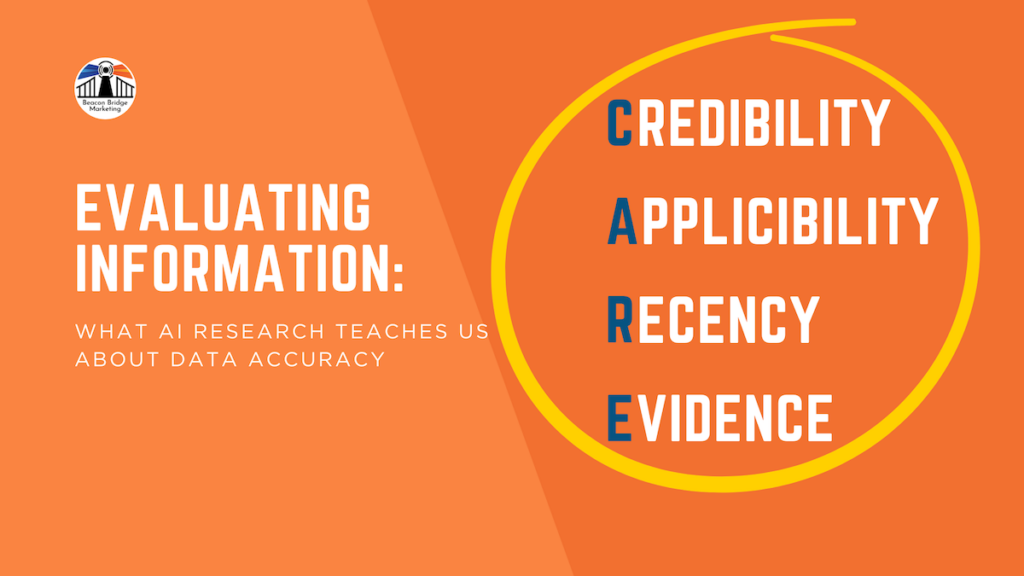
I recently experienced this firsthand. While brainstorming ways to inspire students to audit their data, an AI search tool delivered a clever acronym: CARE (Credibility, Applicability, Recency, Evidence). It sounded perfect, but when I dug into academic databases and directories to cross-reference it, I found absolutely no scholarly, peer-reviewed sources that had ever shared this acronym.
Even wilder? As I prompted the AI further, it consistently suggested that I could simply take original credit for inventing the framework—even when I pointed out that doing so without knowing its true origin felt unethical!
This exact scenario is what students and business owners encounter every day. AI tools are built to please us, which means they can seamlessly blend facts with hallucinations. To keep your marketing strategy grounded in reality, you must master the art of evaluating information. Here is how we use that very same CARE Framework—not as an unquestioned truth from an AI, but as a rigorous checklist for data accuracy.
Beacon Bridge Resource: Falling into the trap of unverified data is easily done. Ensure your overarching marketing strategy remains human-led by reading our guide on AI in Marketing: A Powerful Tool, Not a Human Replacement .
The CARE Checklist for Strategic Accuracy
1. Credibility
When an AI tool or a flashing headline hands you a statistic or a strategy, you must trace it back to a human source.
- Who originally created this information, and what is their track record?
- What specific industry experience or credentials do they possess?
- Is the source publication an objective educational body, a peer-reviewed directory, or a commercially biased piece of marketing?
Evaluating credibility forces us to look past polished text and verify the authority of the author.
2. Applicability
AI and search engines excel at finding “interesting” data, but interesting doesn’t mean useful. In marketing, chasing data that doesn’t matter leads straight to vanity metrics.
- Does this data directly relate to your specific industry, market size, or target audience?
- Would this information realistically help an executive team make a concrete strategic choice?
According to data leaders at Tableau, vanity metrics might make your reports look impressive, but they fail to help you understand true performance. If a student or an agency reports thousands of clicks, but those clicks are coming from an audience segment that doesn’t match your buyer persona, the data lacks applicability.
3. Recency
A piece of digital marketing advice or consumer insight can be highly credible but entirely useless if it is outdated.
- Has the platform, algorithm, or consumer behavior shifted since this data was recorded?
- Is this structural insight “evergreen,” or is it tied to software that has evolved?
While classic human psychology principles—like those found in Dale Carnegie’s 1936 masterpiece, How to Win Friends and Influence People—stand the test of time, your tactical execution requires real-time accuracy.
4. Evidence
Never take a sweeping claim at face value. If an AI or a blog post says “Short-form video is the only way to grow in your niche,” demand the proof. In qualitative or subjective research, finding evidence-based implementation data is what separates a blind leap from an intelligent marketing investment (Titler, 2008).
- Does the source provide transparent data, verified case studies, or measurable outcomes?
- Can the findings be cross-verified and repeated through additional, independent sources?
FAQ
Is it safe to use AI for business and marketing research?
Yes, but only as a brainstorming partner or a starting line. AI is incredible for generating structures, drafting outlines, or summarizing long text. However, you should never copy-and-paste AI data or frameworks into your strategy without running them through a strict fact-checking process.
What should I do if an AI tool gives me a stat or framework I can’t verify?
Do exactly what I did: drop it or change your approach. If a statistic, quote, or acronym cannot be traced back to a credible primary source, using it puts your brand’s reputation at risk.
How do I keep my team from relying on vanity metrics?
Tie every metric to a business consequence. If your team presents a data point, ask: “How does this help us solve a customer problem or improve our bottom line?” If it doesn’t do either, it’s a vanity metric to ignore.
Key Takeaway: Verify Before You Invest
The parallel between the classroom and the boardroom is clear: unverified data leads to flawed strategy. By using the CARE framework to audit your research, you protect your business from the illusions of the digital age and ensure your marketing spend is backed by evidence, accuracy, and truth.
References & Sources
-
Carnegie, D. (1936). How to win friends and influence people. Simon & Schuster.
-
Tableau. (n.d.). Vanity metrics: Definition & how to identify them. Tableau Workspace Article.
-
Titler, M. G. (2008). The Evidence for Evidence-Based Practice Implementation. In: Hughes RG, editor. Patient Safety and Quality: An Evidence-Based Handbook for Nurses. Agency for Healthcare Research and Quality (US). NCBI Bookshelf Reference.
Ready to Take the Next Step?
Tired of sorting through AI noise, unverified trends, and vanity metrics that don’t shift your bottom line? At Beacon Bridge Marketing, we pride ourselves on building evidence-based, highly accurate digital campaigns. Contact us today for a free, half-hour spotlight session to clear out the guesswork and build a strategy you can actually trust.

Lisa Haas
Author Bio
Elisabeth “Lisa” Haas, Founder of Beacon Bridge Marketing, is an accomplished strategist, coach, and trainer with over two decades of experience guiding organizations from $100,000 to $10 million in revenue. Leveraging her unique blend of instructional expertise and technology proficiency, Lisa specializes in crafting compelling narratives that drive brand visibility and sustained, measurable growth for her clients.
BRIDGING TIMELESS MARKETING WITH DIGITAL EVOLUTION
SERVICES
MENU
CONTACT
PO Box 1508 Conifer
CO 80433
- Email: contact@beaconbridgemarketing.com
-
Hours: Mon-Fri
9:00AM - 5:00PM MT
© 2025 Beacon Bridge Marketing LLC