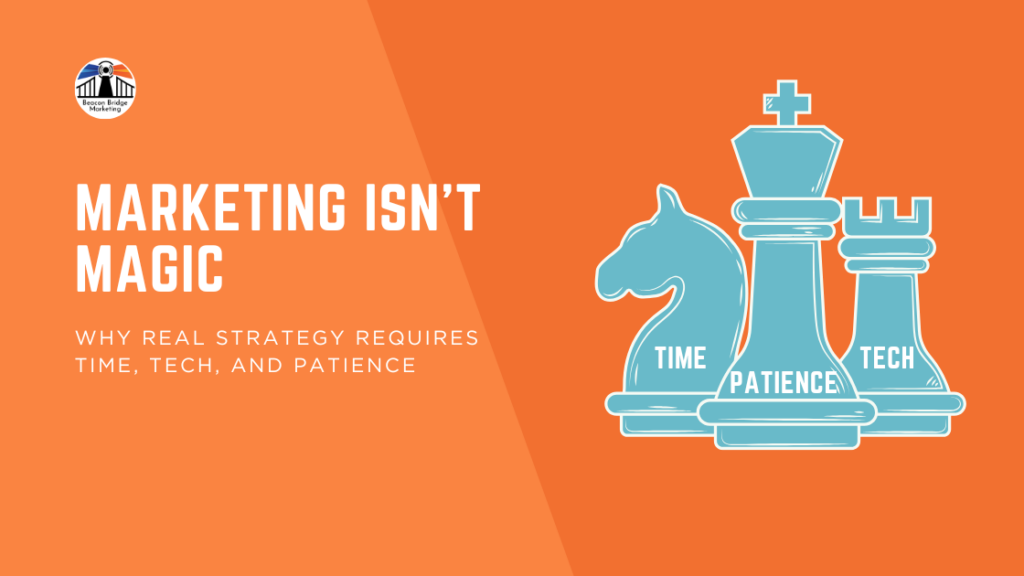
Marketing Isn’t Magic: Why Real Strategy Requires Time, Tech, and Patience
We’ve all seen it happen: a consumer clicks a compelling call-to-action (CTA) button, makes a purchase in seconds, and it feels like instantaneous magic.
What the end user doesn’t see is the 6 to 12 months of testing, tech integration, audience alignment, and strategic refinement behind that single click.
In a world obsessed with quick fixes, it’s easy to treat marketing like a magic wand—wave it around, say “abracadabra,” and watch the revenue appear overnight. But marketing isn’t magic, and there is no silver bullet. Marketing is a core business department. Just like finance, operations, or product development, it requires diligence, technology, skilled people, and above all, patience to let it work.
Building Alignment: The 80/20 Rule of Strategy
To create a system that delivers results, your marketing strategy must align on every level: with your internal team, your brand values, your ideal consumer, and even your customer’s customers.
Most companies in a given industry get about 80% of the basics right. They offer similar products, competitive pricing, and decent service. But that remaining 20% is where the magic actually lives. That 20% is your unique value proposition—it’s the exact reason a customer chooses to buy from you instead of your competitor.
Uncovering and amplifying that 20% isn’t an afterthought. It takes deliberate effort to identify, package, and position it effectively.
Beacon Bridge Resource: Want to make sure your strategy stays grounded in human connection instead of short-lived gimmicks? Read our guide to Stop Chasing Algorithms And Build a Human-Centered Strategy Instead to learn how to build long-term customer loyalty.
Stop Building on Quicksand: Moving Targets and Changing Tech
If marketing felt simpler a decade ago, it’s because the landscape was far less dynamic. Today, relying solely on basic buyer psychology or “color psychology” in your logo isn’t enough.
Marketing is constantly moving because both consumer behavior and technology are constantly shifting. You aren’t aiming at a stationary target with a static bow and arrow.
- Sometimes the market calls for a carrot and stick.
- Sometimes it calls for a fishing pole and patience.
- Sometimes the target itself moves entirely to a brand-new digital platform.
When you rush a campaign or expect immediate results, you’re essentially building on quicksand. Sustainable growth requires you to build a foundation, test the market, analyze the data, and continuously optimize. You have to give your team and your tech stack the space to find what works.
Marketing Is Holistic: Beyond Just “Promotion”
One of the biggest mistakes business leaders make is treating marketing purely as “advertising” or “promotion.” In reality, promotion is just one component of a much broader Paid, Earned, and Owned Media (POEM) strategy—where paid ads, earned media mentions, and owned digital channels work together to create a cohesive brand presence POEM Steric.
More importantly, this media strategy lives inside an even larger, holistic ecosystem built around the 4 Ps of Marketing:
- Product: Identifying genuine human needs and building a solution that solves a real problem.
- Price: Setting a sustainable, competitive value exchange that reflects your offer's true worth.
- Packaging (Place): Delivering and presenting your product so that it is seamless and pleasing for the customer to buy.
- Promotion: Communicating your message clearly to the right people through your POEM channels.
When you rush straight to promotion without laying the strategic groundwork across Product, Price, and Packaging first, you’re asking a team to sell something without knowing if the market even wants it. This is precisely why marketing should be a foundational conversation before a product launches—not an afterthought when sales stall.
Working with subject matter experts ensures that every piece of your marketing engine—from technology and data analysis to messaging and channel selection—syncs in perfect alignment.
FAQ
How long does a new marketing strategy take to show real ROI?
While short-term wins can happen early through paid channels or targeted promotions, a comprehensive digital marketing strategy typically takes 6 to 12 months to fully mature. This timeframe allows for proper data collection, audience testing, search engine indexing, and message optimization.
Why shouldn’t I just copy what my competitors are doing?
Copying a competitor targets their 80% (the baseline standard for your industry) while ignoring your unique 20%. It also assumes your competitor’s strategy is working, which isn’t always true. Sustainable growth comes from leaning into what makes your business distinctly valuable.
What is the difference between marketing and advertising?
Advertising is simply one component of marketing focused on paid promotion. Marketing is the entire holistic business process: researching audience needs, refining the product or service, setting pricing strategy, crafting brand messaging, and managing the customer journey.
Key Takeaway: Give Strategy Time to Work
One-and-done campaigns don’t build legacy brands. Real marketing momentum comes from efficiency, diligence, continuous optimization, and the patience to let data guide your next move. Give your people and your processes the opportunity to do it right.
Stay Tuned: This is just the beginning! Over the coming weeks, we’re kicking off a special 4-part series breaking down the foundational pillars of marketing—so you can build a resilient strategy that stands the test of time.
Ready to Take the Next Step?
Ready to stop chasing silver bullets and start building a real marketing engine? At Beacon Bridge Marketing, we partner with business leaders to develop data-driven strategies that deliver sustainable growth. Contact us today for a free, half-hour spotlight session to discuss your long-term marketing roadmap.

Kris Klenke
Author Bio
A recent University of Denver graduate with Master’s degrees in Marketing Management and Web Design & Development, Kris offers over five years of design and marketing experience. She is passionate about empowering companies to build strong brands and communicate their message effectively through compelling visuals and strategies.

BRIDGING TIMELESS MARKETING WITH DIGITAL EVOLUTION
SERVICES
MENU
CONTACT
PO Box 1508 Conifer
CO 80433
- Email: contact@beaconbridgemarketing.com
-
Hours: Mon-Fri
9:00AM - 5:00PM MT
© 2025 Beacon Bridge Marketing LLC