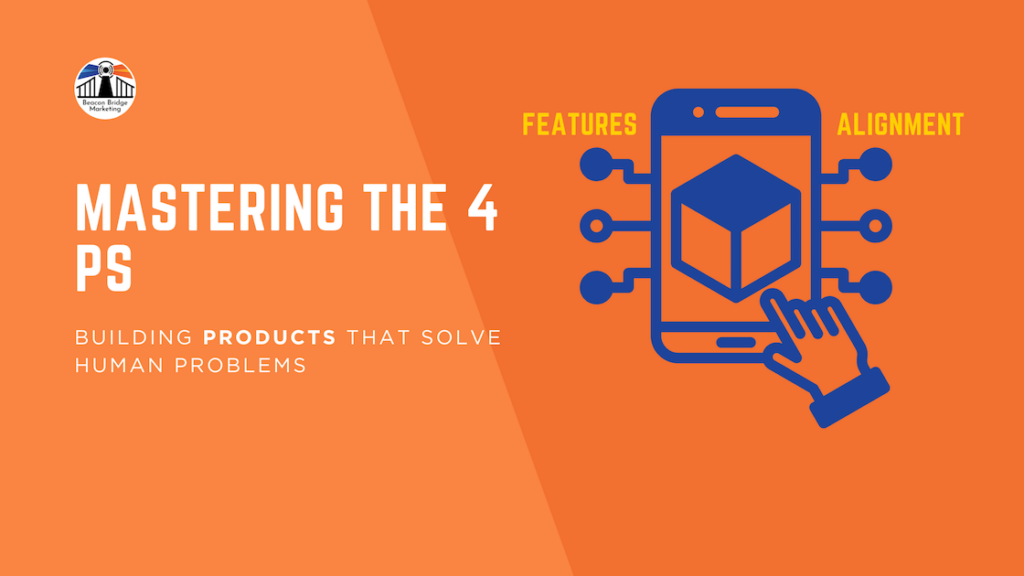
Mastering the 4 Ps: Building Products That Solve Human Problems
In our previous post, we explored a fundamental truth that many business leaders overlook: marketing isn’t magic. It isn’t a quick fix or a secret spell you cast at the end of a sales quarter. It’s a holistic business discipline.
Welcome to Part 1 of our 4-Part Series, where we’re going back to the foundational pillars of business growth: The 4 Ps of Marketing (Product, Price, Packaging/Place, and Promotion).
It’s tempting to jump straight to the fourth “P”—Promotion—and start running ads or creating social media posts. But if you begin there, you’re missing the cornerstone of the entire engine. Great promotion cannot save a product that doesn’t solve a real human problem.
Before you spend a single dollar on ad creative or launch campaigns, your marketing strategy starts with the Product.
Product Is the First Act of Marketing
In a human-centered marketing framework, product development isn’t just an operational task handled in a silo. It is the very first marketing decision you make.
Why? Because true product marketing is the strategic bridge between product development and driving consumer demand. If your product or service doesn’t align with an authentic consumer need, every downstream effort—from pricing to promotion—becomes an uphill battle.
When you start with empathy and deep customer research, product development becomes seamless:
- You stop trying to "convince" people to buy something they don't want.
- You start building solutions that people actively seek out.
- Your marketing messaging writes itself because it speaks directly to a real pain point.
Beacon Bridge Marketing Resource: Unsure if your product concept is backed by real customer demand or just vanity data? Learn how to audit your market research in our guide on Evaluating Information: The CARE Framework for Better Strategy. Human-Centered Strategy Instead .
Features vs. Benefits: What Is Your Customer Actually Buying?
One of the most common traps business owners fall into is getting enamored with their product’s features. You might be proud of your software’s complex code, your consulting framework’s 12-step process, or your product’s durable materials.
However, customers don’t buy features; they buy transformations. They buy outcomes, relief, time saved, or status gained.
- A feature is what your product is or has (e.g., a 100% cotton blanket).
- A benefit is what your product does for the human using it (e.g., a restful night's sleep without overheating).
To build a product that resonates, ask yourself: What is the emotional or practical shift my customer experiences after using this? When you design your offering around that human transformation, your product becomes a natural fit for your target market.
The 80/20 Alignment: Product Positioning
As we introduced in our “Marketing Isn’t Magic” overview, most competitors in your industry will cover the baseline 80% of what customers expect. They have a working product, basic customer service, and standard delivery.
Your Product Strategy is where you define that crucial 20% through intentional product positioning. Positioning is how you articulate your product’s unique space in the marketplace so target customers clearly see why your solution is distinct from everything else available.
By actively listening to customer reviews, conducting surveys, and studying where existing solutions fall short, you can uncover the friction points others ignore. Maybe competitors offer a great tool, but their customer onboarding is confusing. Maybe their product works well, but it lacks an essential feature for small businesses. Filling that specific gap is how you create a product that commands market authority.
FAQ
What if I offer a service instead of a physical product? Does this still apply?
Absolutely! In marketing, a “Product” refers to whatever offer you bring to the market exchange—whether it’s a physical item, a digital download, a professional service, or a subscription program. The same rules apply: your service must solve a clear, specific problem for a defined audience.
How do I know if my product solves a real problem before launching it?
Conduct qualitative customer interviews, pre-sell the offer, or launch a minimum viable product (MVP) to a small test group. Look for genuine willingness to pay or deep engagement, rather than polite verbal compliments. Real market feedback is the ultimate test of product-market fit.
When should marketing get involved in product development?
From day one. Marketing should help inform product features, audience positioning, and messaging research before the product is finalized, ensuring you build something the market already wants.
Key Takeaway: Start with the Solution
Before you write a single headline or set an ad budget, anchor your business in a product that genuinely serves your audience. When your offer delivers undeniable value, every other part of your marketing engine becomes infinitely easier and more effective.
Up Next in Our Series: Now that we’ve built a product that solves a real human need, how do we value it? Join us next month for Part 2: Price — The Psychology of Value and Position.
Ready to Take the Next Step?
Unsure if your current product positioning or service offer is hitting the mark with your ideal clients? Beacon Bridge Marketing helps business leaders align their products with genuine market demand. Contact us today for a free, half-hour spotlight session to refine your offer and build a foundation for long-term growth.

Kris Klenke
Author Bio
A recent University of Denver graduate with Master’s degrees in Marketing Management and Web Design & Development, Kris offers over five years of design and marketing experience. She is passionate about empowering companies to build strong brands and communicate their message effectively through compelling visuals and strategies.
BRIDGING TIMELESS MARKETING WITH DIGITAL EVOLUTION
SERVICES
MENU
CONTACT
PO Box 1508 Conifer
CO 80433
- Email: contact@beaconbridgemarketing.com
-
Hours: Mon-Fri
9:00AM - 5:00PM MT
© 2025 Beacon Bridge Marketing LLC